
784: Double Purse String Anastomosis After Anterior Resection of the Recto-Sigmoid–Jenny Thomas
This is one of the entries accepted for adjudication for the 2026 KS Innovation Awards, sponsored by the Vattikuti Foundation. Posting here does not imply being a Finalist.
Here is the Abstract:
Robotic Low Anterior Resection with Single Stapled Double Purse-String Anastomosis (SSDP): Technique and Clinical Outcomes
Dr. Jenny Thomas
Apollo Hospitals , Navi Mumbai , India
jen.thomas2769@gmail.com
PURPOSE:
Anastomotic technique is a critical determinant of outcomes following anterior resection of the recto-sigmoid colon. Traditional double-stapled techniques are widely adopted but carry drawbacks, notably intersecting staple lines that can predispose patients
to anastomotic leakage—a major driver of postoperative morbidity and mortality. The single stapled double purse-string anastomosis (SSDP) was developed to eliminate these overlapping intersections by securing a single staple line within two circumferential purse- string sutures. The purpose of this video is to illustrate this technique during robotic anterior resection and evaluate its safety, technical execution, cost effectiveness and clinical outcomes.
METHOD:
A 70-year-old female (ECOG 0) presented with rectal bleeding. Colonoscopy revealed a recto-sigmoid growth obstructing greater than 50% of the lumen, confirmed via biopsy as moderately differentiated adenocarcinoma. A baseline FDG PET scan showed localized
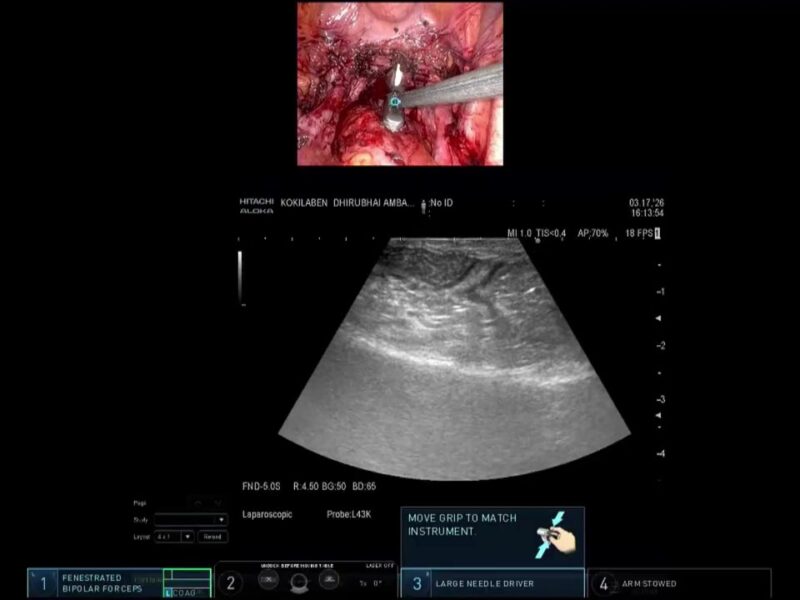
disease with no distant metastasis. After achieving a partial response to 4 cycles of neoadjuvant FOLFOX chemotherapy, the patient underwent a robotic low anterior resection (LAR) with SSDP anastomosis . The surgery was performed entirely intracorporeally using the Da Vinci Xi surgical system with standard LAR port placement and colorecatal anastomosis done with double purse string technique
RESULTS:
The intraoperative and post operative period was uneventful. The technique was successfully executed, yielding circumferentially complete proximal and distal donuts. The immediate postoperative period was uneventful. The patient recovered well.
CONCLUSION:
The single stapled double purse-string anastomosis is a technically feasible, totally intracorporeal, and clinically effective method for restoring bowel continuity after robotic anterior resection. By eliminating intersecting staple lines, the SSDP technique
mitigates a key mechanical risk factor for leakage. In this case, the approach yielded no anastomotic leak and excellent clinical recovery, demonstrating a strong safety profile while offering the added benefit of cost-effectiveness through the use of a single stapler.
See more at: http://vattikutifoundation.com/
Date
August 15, 2020