

Welcome to the Vattikuti Innovators Challenge 2025!
What is the Vattikuti Innovators Challenge?
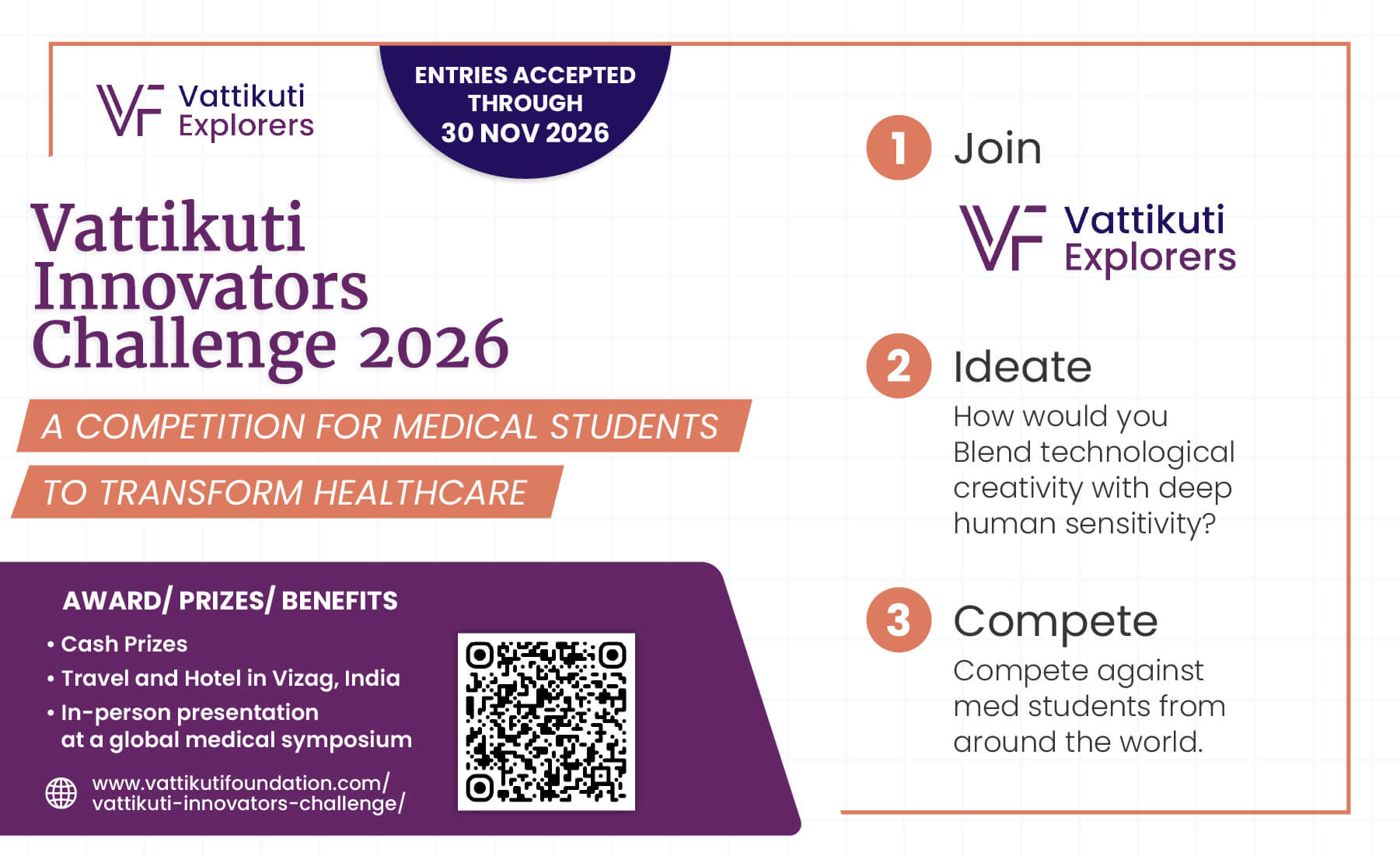
The Vattikuti Innovators Challenge (VIC) is a competition for medical students worldwide. The purpose of the competition is to see who can come up with out-of-the-box ideas and solutions to address problems in medicine.
Teams of 2 will work together to solve the competition question which will be provided once registered. Teams can be self-selected or assigned.
VIC 2026 Competition Theme:
Global Medical Student Disaster Leadership Challenge - 72-Hour Response: Catastrophic Floods in Rasuwa, Nepal
Details of the case and competition can be downloaded here:
What this competition is testing
- Leadership without relying on a rigid top-down hierarchy
- Organizational skills and shared decision-making
- Problem identification, prioritization and triage
- Supply-chain and resource management
- Appropriate application of technology
- The human side of medicine: empathy, uncertainty, communication and dignity
- The ability to think globally and act locally
- Pragmatism: making defensible decisions when resources and information are incomplete
- Ownership: creating a clear vision and acting rather than waiting for ideal conditions
Competition Process
Team Requirements
Team Composition:
- Submissions to be made by teams of two Explorers
- Teams of two are self-selected but both members must be current Explorers
- Teams may consist of partners from the same school, different school, or different countries. If help is needed to find a partner, contact Sarika Mehta sarika@vattikutifoundation.com
- Each team is encouraged to seek external advice, data and input from mentors, and experts
Submission format:
- PDF submission
- Maximum 3,250 words, excluding title page, table of contents, abstract, 72-hr action plan required tables/graphics and references
- Single spacing; 12-point readable font
- Graphics, maps, diagrams and illustrations are encouraged where they clarify decisions
- Data and analytics should be used where relevant
- All external factual claims and borrowed ideas must be referenced
- Maintain patient privacy
Written submission
- Title Page – Challenge title; team name; both team member names; year in medical school; medical school(s); country/countries.
- Abstract – 400-500 words – Briefly state the understanding of the problem, approach, major priorities, and intended 72-hour outcome.
- Situation Analysis – 200-300 words – Identify the three most important problems, the populations most at risk, critical geographic/system constraints, key missing information, and what must happen first.
- Leadership & Organization – 300-400 words + visual – Provide one organizational visual. Explain how responsibilities are distributed, how decisions are made, how local expertise is incorporated, and how the structure avoids unnecessary top-down bottlenecks.
- Patient Prioritization & Triage – 400-500 words + table – Triage all 40 patients using an action framework that can be explained. Identify five requiring the most immediate attention, three who may indicate a larger community problem, and three for whom missing information is especially important.
- Resource & Supply-Chain Plan 300-400 words + visual – Show how personnel, medicines, transportation and information will move. Include a resource-flow visual and explain how to manage scarcity, inventory, resupply and isolated communities.
- Technology: Use It – or Don’t – 200-300 words – Select no more than three technologies. For each, state the problem solved, operational requirements, failure mode and backup. Identify one plausible technology that would deliberately not be used and explain why.
- Think Globally, Act Locally – 200-300 words – Identify one external lesson/model that exists and how it was adapted for Rasuwa, and one assumption that changed because of the team’s different perspectives or research.
- Human Side of Medicine – 200-300 words – Choose one patient/family situation. Explain what the team still needs to learn, how the team would communicate, and how emotional, cultural or family needs influence the response. Do not invent unknown facts.
- 72-Hour Action Plan – Provide a one-page timeline for Hours 0-6, 6-12, 12-24, 24-48 and 48-72. End with five measurable indicators that exhibit whether the response is working.
- Conclusion – 250 words – In a concise personal synthesis, state the single most important leadership choice the team made and what was learned from working across perspectives.
- References – List credible sources used for disaster context, methods, technology, logistics, public health or other evidence.
Written Narrative
Format:
PDF format with single spacing, 12-pt font.
Graphics:
Use graphics, pictures, and illustrations to enhance the presentation
Data:
Inclusion of data and analytics
Finalists will be notified via email after 1 January 2027
What happens for the top 5 teams?
In-Person Presentations:
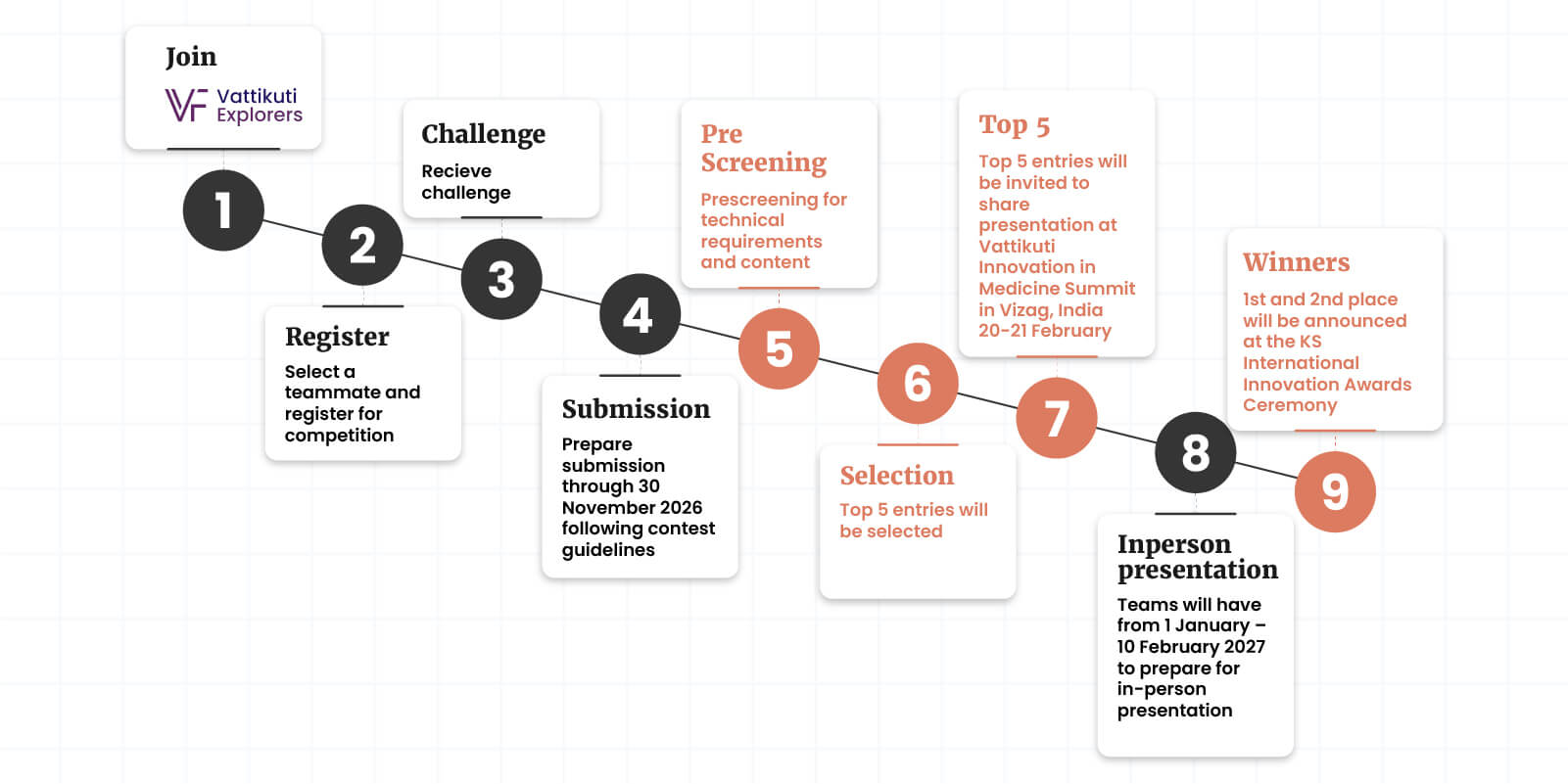
- International Academic Symposium: Vattikuti Innovation in Medicine Summit, Vizag, India on 20-21 February 2027
- For the selection of semi-finalists on January 1, 2027, there will be a total of five teams based on the top-ranking submissions. This group of ten will be invited to present their submission at the international audience of attendees at the academic symposium, Vattikuti Innovation in Medicine Summit to be held in Vizag, India on 20-21 February 2027.
- Teams will have from 1 January 1 –10 February 2027 to prepare for in-person presentations and podium time at the symposium.
- Top 5 teams will be paired with a mentor by the Vattikuti Foundation for finals round preparation
Awards
Top 5 teams will be eligible for a travel allowance to attend symposium and awards ceremony in Vizag, India, including hotel accommodations for two nights, meals and free registration to the event.
First Prize:
$1,000 USD
Runner-up:
$500 USD
Cash prizes to be announced and awarded at the KS International Awards Ceremony
Saturday 20 November 2027 – Novotel Vishakhapatnam Varun Beach Resort
Qualifications for All Applicants
All entrants must be currently enrolled as a Vattikuti Explorer.
Vattikuti Explorers enrollment details found on the Vattikuti Foundation website https://vattikutifoundation.com
Key Dates
Closing Date:
30 November 2026
Finalist Selection:
1 January 2027
Academic Symposium:
20-21 February 2027 (Vizag, India)
Awards Ceremony:
20 February 2027 (Vizag, India)
For questions, contact Sarika Mehta at sarika@vattikutifoundation.com