
689: Single-Docking Robotic Approach to Abdominal and Thoracic Paraganglioma- Girdhar Bora
This is one of the entries accepted for adjudication for the 2026 KS Innovation Awards, sponsored by the Vattikuti Foundation. Posting here does not imply being a Finalist. Here is the Abstract:
Crossing the diaphragm, closing the case”: A Single-Docking Robotic
Approach to Abdominal and Thoracic Paraganglioma for
Pheochromocytoma–Paraganglioma Syndrome
Primary Contact: Dr Girdhar Bora, Additional Professor , Department of
Urology , PGIMER, Chandigarh , email : girdhar2k@gmail.com
Abstract
Introduction: Patients with synchronous abdominal and intrathoracic lesions traditionally
require separate transabdominal and transthoracic approaches, necessitating repositioning,
additional ports, and increased operative time. In this video, we demonstrate an innovative
single-docking robotic technique, highlighting preoperative planning, strategic port placement,
surgical execution, and successful outcomes while minimizing procedural complexity and
operative burden.
Case summary:
We present the case of a 31-year-old woman with SDHD-mutated hereditary
PGL/PCC syndrome who had undergone left adrenalectomy with partial right adrenalectomy
for bilateral pheochromocytoma seven years earlier. She presented with recurrent hypertension
and headache, and was found to have metastatic recurrence involving the residual right adrenal
gland, a right paravertebral (intrathoracic; D9–D10) soft-tissue deposit, an aortocaval
paraganglioma.
Video summary:
After multidisciplinary evaluation and alpha/beta-adrenergic blockade
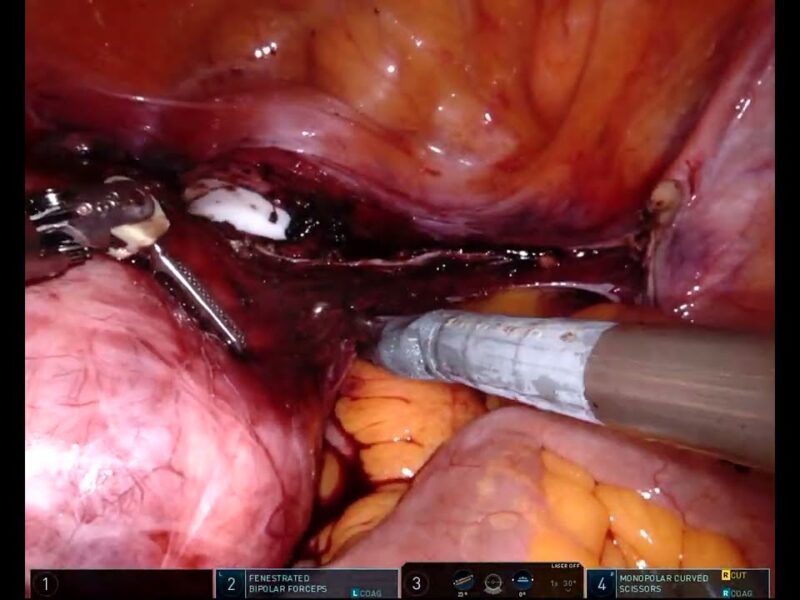
optimisation, she underwent robot-assisted completion right adrenalectomy with
retroperitoneal (aortocaval) paraganglioma excision, transdiaphragmatic excision of the right
paravertebral mass, in a single robotic sitting. The operative steps — port placement,
mobilisation of the liver and residual adrenal, control of the adrenal vein, aortocaval lymph
nodal dissection, transdiaphragmatic access to the posterior mediastinal/paravertebral deposit,
and diaphragmatic repair — are demonstrated.
Results:
Estimated blood loss was 300 mL, with no major intraoperative complications. The
patient was extubated uneventfully, managed with a perioperative hydrocortisone taper, and
discharged on postoperative day 4 in a stable condition. Final histopathology confirmed
metastatic pheochromocytoma in the thoracic paravertebral lesion and aortocaval
paraganglioma, with a microscopic focus in the resected adrenal gland.
Conclusion: Robotic surgery is a safe and effective minimally invasive option for excision of
recurrent, multifocal and metastatic paraganglioma/pheochromocytoma involving the adrenal
bed, retroperitoneum, and posterior paravertebral/mediastinal locations, and allows combined
multi-site clearance in a single setting with acceptable morbidity.
See more at: http://vattikutifoundation.com/
Date
August 15, 2020